





Composite Deck Board Comparison: Fiberon vs. Trex vs. TimberTech
September 4, 2026 | By Pat Ward
You know you want a composite deck. But what brand offers the best composite deck boards?
In this article, we discuss three of the most popular and highest-quality composite decking manufacturers in the US: Fiberon, Trex, and TimberTech. We compare how each of their composite blends differ in cost, strengths, weaknesses, and performance in Michigan’s climate.
At C&L Ward, we want each homeowner to find the best solution for their home and needs. While we exclusively offer Fiberon decking products, we want our clients to understand how a variety of options perform.
By the time you’re done reading, you’ll have a better understanding of how composites differ and which brand is best for your deck.
To read more in-depth about how composite deck boards compare to other materials, visit our article, “Wood, Composite, or PVC Deck: Which Decking Type Is Best for Michigan Homes?”
Table of Contents
Fiberon vs. Trex vs. TimberTech: What are they made of?
If you’re reading this article, there’s a good chance you’ve heard of composite decking before. Composite decks are made from a blend of wood and other materials, typically plastic.
All three manufacturers—Fiberon, Trex, and TimberTech—use a blend of wood and plastic to create their boards, though in different ratios. All three also use recycled content, though the exact percentage varies.
Brand | Composition | |
Fiberon | 94% recycled materials: half wood, half plastic | |
Trex | 95.4% recycled materials | |
TimberTech | 65% to 85% recycled materials | |
Percentages via Rocky Mountain Forest Products
They are coated or ‘capped’ on 3 or 4 sides to create a durable barrier between the composite core and the natural elements. 3-sided caps cover the top and sides of the board, whereas 4-sided capping also covers the underside of the board.
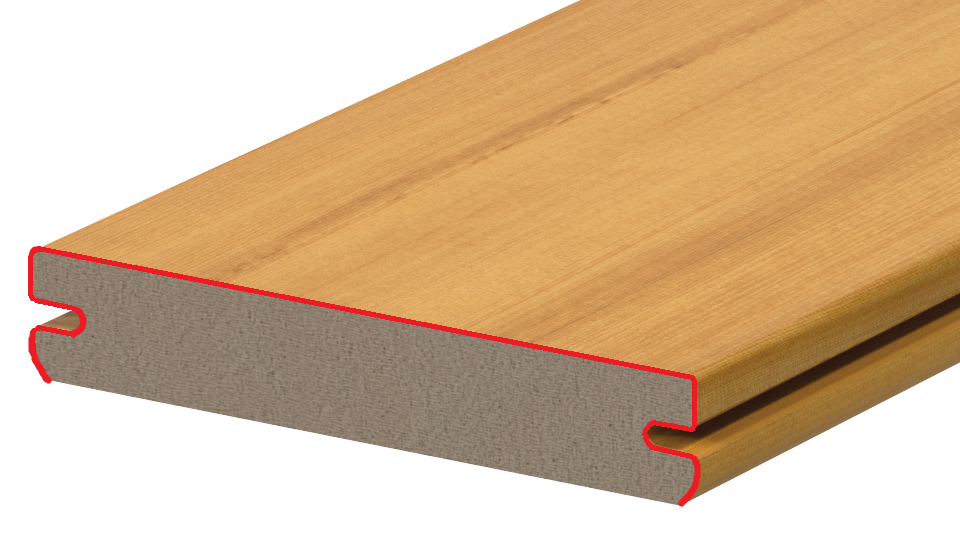
3-Sided capped composite has a protective layer on three surfaces: the top of the board and both sides.
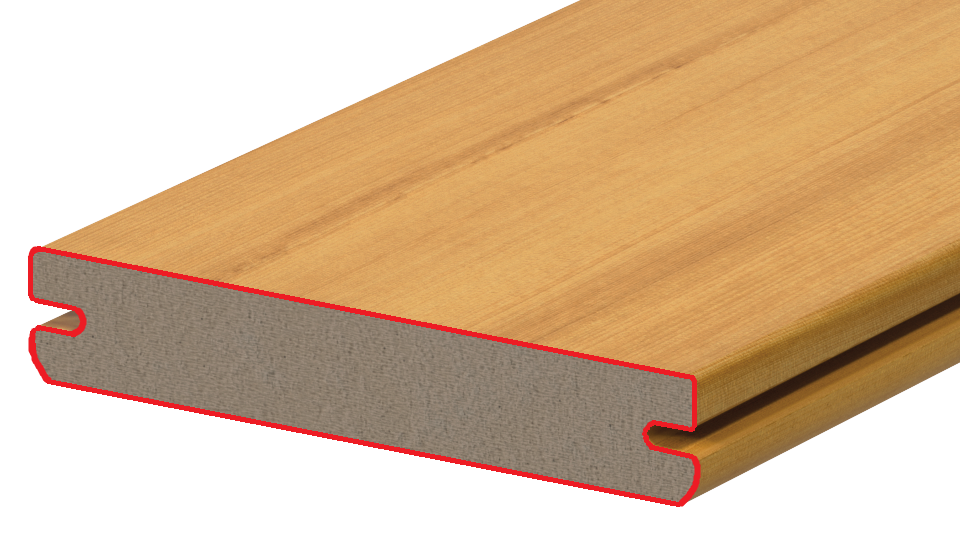
4-Sided or Full-Wrap capped composite has a protective layer on four surfaces: the top and bottom of the board and both sides.
4-sided capping may be preferable if the bottom of your deck is visible, or if your deck will be built in a high-moisture area. If your deck has good airflow, 3-sided capping is the more cost-effective option.
Brand | Capped | |
Fiberon | 3-Sided or 4-Sided | |
Trex | 3-Sided | |
TimberTech | 3-Sided or 4-Sided | |
What Do New Fiberon, Trex, TimberTech, and Wood Decks Cost?
Trex and Fiberon are the most cost-friendly decking options of the three. Trex is the most budget-friendly option by about $25 per 100 square feet, or $0.25 per square foot.
TimberTech has the highest price tag, charging about $800 more for a 100-square-foot deck than other brands, or $8 more per square foot.
Brand | Starting Price: Cost for 100 square feet of decking | |
Fiberon | $626+ | |
Trex | $600+ | |
TimberTech | $1,400+ | |
Bear in mind that these are starting prices for deck boards alone. Certain product lines may cost more, and the above price does not include railings, structures, or other custom decking options.
What Type Of Maintenance Is Required for Fiberon, Trex, or TimberTech Decks?
Maintenance is relatively identical across composite decks. They may need an occasional rinse with water and mild soap, but should never be power-washed or treated with harsh chemicals.
Composite decks should also never be sanded, stained, or painted.
How Does Each Composite Board Perform in Michigan’s Climate?
With hot summers and icy winters, many Michigan homeowners wonder how composite decks will perform in these seasonal extremes.
Summer: Board Temperature and Heat
One of the most common questions homeowners ask us is, “Don’t composite decks get hot?” Our answer is that it depends on the manufacturer and that technology keeps improving.
There isn’t a consistent way to measure how well a deck board reflects heat, but there are a few things you can do to help keep temperatures down if you are worried about deck boards warming up. Lighter colors tend to retain less heat, and a shade structure such as a pergola further helps keep decks cool.
Lee Roy Jordan Lumber Company identifies Fiberon, Trex, and TimberTech as well-known, heat-resistant, composite brands.
Winter: Anti-Slip Technology
Anti-slip resistance is measured in coefficient of friction (COF) on a scale of 0 (no friction) to 1. The closer to 1 a product is rated, the less slippery it is.
Deck boards have two anti-slip ratings, one for dry boards and one for wet. Deck boards are made less slippery with embossed grooves and added textures, which provide better grip in addition to mimicking the look of real wood.

*TimberTech shares the COF ratings of their PVC boards, but not those of their composite lines. TimberTech advertises that the anti-slip features of their boards perform up to 40% better than competitors.
How Do Fiberon, Trex, and TimberTech Deck Warranties Compare?
Fiberon, Trex, and TimberTech each offer fade and stain resistance and a minimum of a 25-year warranty.
These warranties do differ, however. Fiberon offers a product warranty that covers materials and a labor warranty that may cover labor costs if you ever need a replacement or repair.
Product warranties alone, such as those offered by Trex and TimberTech, cover material costs but do not cover labor. That cost falls on the homeowner.
Brand | Warranty or Warranties | |
25- to 50-year Product Warranty (physical integrity, stain & fade resistance) 5-, 10-, or 15-year Limited Labor Warranty | ||
25- to 50-year Limited Warranty (fade and stain resistance) | ||
25- to 30-year Limited Warranty | ||
To learn more about different warranty types, explore our article, “What are the Different Types of Home Exterior Improvement Warranties and What do they Protect?”
When Are Fiberon, Trex, or TimberTech a Great Fit For You?
Fiberon: Best Cost for Advanced Options
Fiberon offers more options than Trex, but isn’t limited to high-end-only like TimberTech. This allows Fiberon’s composite decking to offer a wider range of choices, while keeping prices in the low-to-mid range compared to other quality options.
Trex: Best Cost for Basic Options
Trex offers the lowest price on composite deck boards. If you’re looking for a 3-sided capped board without sacrificing quality, Trex might be the best pick for you.
TimberTech: Best for Finishes and Grain
Fiberon and Trex both offer realistic wood finishes, but TimberTech takes it a step further by offering a variety of faux cuts and finishes. You can choose from more texture or less, with or without knots, and take the realism to another level.
When Are Fiberon, Trex, or TimberTech Not the Best Fit For Your Home?
Fiberon: Not for Custom Grains
While Fiberon offers a realistic, straight-grain wood finish, they don’t manufacture the variety of wire-brushed, crosscut, or hand-scraped finishes that TimberTech does. If the grain of your deck boards is as important to you as the color, Fiberon may not be the way to go.
Trex: Not for the Custom Color Deck
If you want 4-sided capping or more custom options, Trex may not be the pick for you. Depending on the line you select, Trex boards are only available in 2 to 10 colors. If you want a specific color, or a variety of colors to choose from, Trex may be more limited than other brands.
TimberTech: Not for the Budget-Conscious Buyer
TimberTech makes quality deck boards. (We wouldn’t have included them in this article otherwise!) But they are more costly than other composite options. If you’re looking to balance price with function, TimberTech may not be the best product for your home.
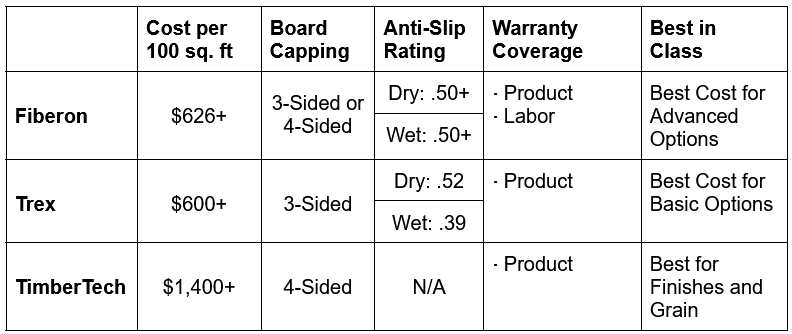
Quick Comparison Chart: Fiberon vs. Trex vs. TimberTech Deck Boards
How to Compare Decking Costs and Installers
Now that you understand the differences between composite deck brands, you might feel ready to start researching, “How Much Do New Decks Cost in Michigan?” You can also visit C&L Ward’s Deck Pricing page to explore options and receive an instant price range for what you can expect to pay for your project.
If you’re ready to start considering contractors, we recommend reading our article, “The Best Deck Installers in Southeastern Michigan: A Comprehensive Comparison.”