






What are the Different Types of Home Exterior Improvement Warranties and What do they Protect?
Apr 03, 2026
By Pat Ward
Table of Contents
There are many warranties available, with some installers offering multiple warranties for different products. They might be limited warranties, lifetime warranties, or warranties specified by a specific number of years.
So, what does it all mean? With this article, we aim to define common warranties and educate clients on what they cover, what they don’t, and how long their protection lasts.
Disclaimer: This article is written to help inform and educate, but it does not serve as—nor is it a substitute for— professional legal advice. If you seek these services, please contact a qualified legal professional.
What is a Warranty?
A warranty is a written, legal statement that ensures certain services or protections. In some cases, “it holds the maker of the product responsible to repair or replace a defective product or its parts.” [1] In others, it holds either the manufacturer or installer responsible for damages.
An express warranty is a specific promise made by the seller. A good way to tell if a warranty is an express warranty is if it is quantitative, or contains a number. “This window will last you at least 20 years,” is an express warranty. [2]
An implied warranty is protection implied by State law.
Do all Michigan Contractors offer Warranties?
No, not all contractors offer warranties, as the state of Michigan does not require installers to provide warranties of any kind, or for any period of time.
This means that you will want to receive written, official documentation of any promised warranties before committing to a project. This will help to hold the installer accountable and protect you (and your home) should any issues arise.
A verbal agreement is difficult to prove. You should not accept an oral statement as legally binding.
A good contractor will offer one or many warranties, along with documentation, and will not hesitate to show you proof if asked.
What’s The Difference Between A Limited vs. Lifetime vs. Transferrable Warranty
Limited Warranty
Regardless of what your warranty covers, it will be either good for a limited period of time or good for a lifetime.
A limited warranty covers a pre-determined timeframe. This could be months or, more likely, years. Some may cover 5 years, whereas other limited warranties may cover up to 50 years. The amount of time will vary depending on the product and installer, so be sure to ask.
Also note that some limited warranties may promise coverage “up to” a certain number of years. If you see the phrase “up to,” ask if your purchase will receive this full coverage, or a smaller portion of it.
Lifetime Warranty
There is no legal definition for a “lifetime” warranty. In some cases, it may be for as long as you own your home. In other cases, it may even protect you and the next owners of your home.
Example 1
Fiberon offers a Lifetime Performance Warranty on PVC decking. In their full residential warranty, Fiberon defines this timeframe as:
“The Warranty Period begins on the date of original purchase and continues until the earlier of (a) the expiration of the applicable Warranty Period, or (b) until You no longer own the property upon which the Product was installed for a residential application.”
Since the Lifetime Warranty has no set expiration date (5-years, 10-years), this means that the Lifetime Warranty ends if/when you no longer own that home.
Sometimes, a lifetime warranty will cover the lifetime of the product, meaning as long as it is still being produced or manufactured.
Example 2
Norandex offers a Limited Lifetime Warranty on siding. In their warranty, Norandex specifies that:
“Norandex reserves the right to discontinue or modify any of its vinyl siding products, including the color, and shall not be liable as a result of such discontinuance or modification, nor shall Norandex be liable in the event the replacement material varies in color or gloss in comparison to the original product as a result of normal weathering. If Norandex replaces any material under this Warranty, it may substitute products designated by Norandex to be of comparable quality or price range in the event the vinyl siding product initially installed has been discontinued or modified.”
This means that, should Norandex change or discontinue the siding you purchased, your Lifetime Warranty may cover a replacement with a similar product, but not the original material.
Other manufacturers may follow similar practices or cease to honor the warranty once the original product is discontinued.
Transferrable Warranty
A warranty can be limited or lifetime and still be transferable. A transferable warranty means the provided protection can move, or “transfer,” from one party to another.
For example, Andersen offers a transferable warranty on their window products. Because we install Andersen windows to Andersen’s standards, that warranty transfers from Andersen to us, so we can offer it to you.
What Violates a Warranty?
A warranty can be violated, meaning the protection it provides you is terminated due to a client or installer error.
For example, the Therma-Tru doors we use are protected under a warranty with very strict guidelines. If we used the wrong screws we used to install your Therma-Tru door (screws that were not approved within the specifications of the warranty), the warranty Therma-Tru provides would be invalid.
Normal wear-and-tear may be covered by some warranties, but damages inflicted by a resident would not be.
What Types of Warranties Are There?
Different warranties protect specific, distinct aspects of your project. For example, an installation warranty will protect you from damages incurred during labor, but not damages resulting from the manufacturing process.
A manufacturer’s warranty will protect you from damages during production, but not during installation. This is why it is important to have many strong warranties, to protect your purchase throughout every step of the process.
Installation Warranty aka Craftsmanship Warranty or Workmanship Warranty
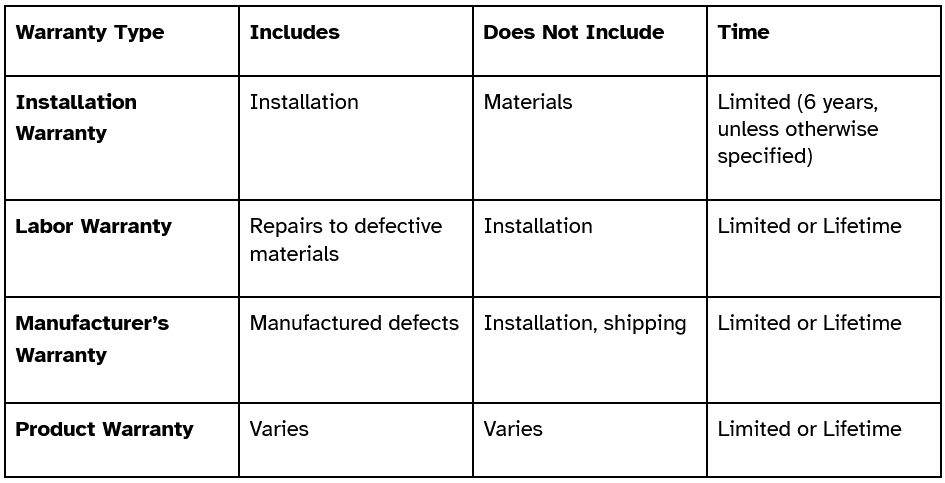
An Installation Warranty (also known as a Craftsmanship Warranty, Workmanship Warranty, or Warranty of Good Workmanship [3]) ensures that the product will be installed and completed sufficiently free of major defects on the fault of the installer.
This protects you from failures resulting directly from the laborer, but does not protect you from faulty products or damages incurred during manufacturing.
If an installer does not specify a timeframe for their Installation Warranty, it may fall under the state’s Statute of Limitations [4], which in Michigan is six years. [5]
Labor Warranty
A Labor Warranty covers the cost of labor to repair material defects. It does not cover installation. [6]
Because Michigan does not set any mandatory warranty requirements, the length of this warranty will depend on the contractor.
Manufacturer’s Warranty
A manufacturer’s warranty covers your product from defects or failures that are a result of the production process.
If you have a door that is damaged during manufacturing, this warranty will cover it. It does not protect products that are damaged during installation, or products that are damaged in shipping.
Timeframe varies depending on the product. Some doors may be protected for up to 5 years, while some windows may be protected for 20 years or more.
Product Warranty
A product warranty is “a promise by the supplier or manufacturer as to the quality of a product.” [7] This warranty will specify certain protections beyond those that are implied by the law.
This means that the terms of a product warranty will vary by seller, manufacturer, and/or product.
However, these terms will give you a clear understanding of what is covered and what is not, rather than leaving conditions implied but left unsaid.
A Quick Comparison of Warranty Types
What is the Difference Between a Guarantee and a Warranty?
As we learned at the beginning of this article, a warranty is a statement that holds the manufacturer or installer responsible for defective or damaged products and the replacements or repairs required to fix them.
A guarantee can be “an agreement assuming responsibility to perform, execute, or complete something and offering security for that agreement” or “something that assures a particular outcome or condition.” [8]
In other words, a written guarantee may function similarly to a warranty. In certain circumstances, it can be legally binding. [9]
However, a guarantee that is too vague, not in writing, or not signed by the guarantor are not legal obligations.
What Risks Should I Look Out for in a Warranty?
The biggest thing to avoid is a solely verbal promise. Saying a product is covered by a warranty or guarantee is, on the whole, meaningless. Only written, signed documents are legally recognized.
Avoid any seller that pressures you to agree to a project without written proof of protection, and make sure that you ask questions in order to fully understand what is covered by the installer, by the manufacturer, how long this coverage lasts, and what invalidates your protections.