





Should I Repair or Replace My Siding?
How to know whether to repair a damaged section or replace it all
If you can see your siding is worn or damaged from the road, it might be time to take a closer look. Maybe you haven’t observed any damage, but you’ve noticed that your energy bill is inexplicably rising. If you’re reading this article, you likely already suspect a problem.
At C&L Ward, we’ve helped more than 2,300 Michigan homeowners identify and resolve their siding issues—from wanting a new look to fixing underlying damage. As a CertainTeed Trained contractor, we’ve seen every cause of siding damage and every effective solution over the past 54 years.
By reading this article, you’ll learn when to repair your siding, when to replace it, and how to perform a basic inspection at home.
Table of Contents
What Factors Determine Whether Siding Repair or Replacement Is Best for My Home?
1. Age
If your siding is relatively new, a repair is likely the most cost-effective option. If your siding is nearing the end of its expected lifespan, it’s probably time to consider a replacement.
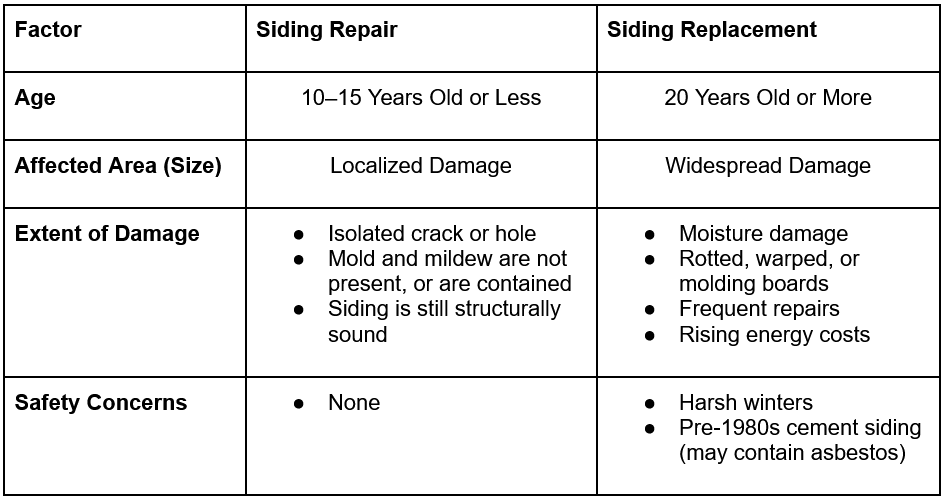
Vinyl, composite, or engineered wood siding that is 10 to 15 years old or less leans towards ‘repair.’ Siding that is 20 years old or more leans towards ‘replace.’
Fiber cement, cedar, and metal siding can each endure for about 50 years, give or take. Siding 40 years old or less should be repaired. If your siding is older than that, consider replacing it.
Learn more about how siding materials compare in “Vinyl, Composite, Wood, or Metal: Which Siding Material Is Best for Michigan Homes?”
2. Size of Affected Area
If your siding has localized damage (10% or less affected), repair is probably a good option.
If the damage is widespread and affects 30% to 50% or more of your siding, it’s time to replace it. Typically, if one wall of siding is experiencing these issues, the other walls may be internally compromised as well, even if they aren’t showing the same signs externally.
3. Type and Extent of Damage
An isolated crack or hole can usually be repaired by replacing a board. So long as there is no mold or mildew growing, or it is contained, and your siding is still structurally sound, repair may be the best fit for your home.
Any moisture damage, such as rotted, warped, or moldy boards, indicates it’s time to replace your siding. Frequent repairs can also signal it’s time to replace. So can unexplained spikes in energy costs.
4. Safety Concerns
Weather:
Your environment can influence your timeline and whether a siding repair or replacement is best. If you live in an area with frequent storms, severe weather, or extreme temperatures, address siding issues quickly.
What starts as a ‘little’ problem can quickly compound with water damage and become a much bigger—and more expensive—fix.
In other words, smaller, repairable damage can turn into a bigger problem the longer it sits unaddressed and exposed to the elements. The harsher the season, the faster this deterioration can occur.
Asbestos:
Note that cement siding installed prior to the 1980s may contain asbestos, a known carcinogen. This material is dangerous to sand and should not be painted over. Cracks or holes can increase risk of exposure.
If you have or think you may have asbestos in your siding, call a professional who can safely remove and dispose of it—don’t wait until it’s damaged or attempt to resolve the issue with a DIY project.
How Do I Know When to Choose Siding Repair or Replacement?: Quick Comparison Chart
What is Siding Repair?
Siding repair involves replacing just the board(s) experiencing a confined issue. For example, you can remove a board with a woodpecker hole and replace it with a new one.
Oftentimes, the color of your new board will match your existing boards. There may be slight color variations between boards, especially if your siding has faded with age or sun exposure. This is most common on south-facing walls.
In some cases, the manufacturer may no longer produce your original siding. In such cases, a similar color will be selected instead. A quality contractor will let you know this in advance and involve you in the process of selecting a satisfactory match.
When Is Siding Repair A Good Solution?
Siding repair is a good solution when the damage is confined to 10% or less of your home, your siding is still structurally sound, and there is no (or contained) water damage or safety concerns.
Repair can be cost-effective, especially if your siding is newer or still in the early years of its expected lifespan.
How Do I Know When I Should Replace My Siding?
You know it’s time to replace your siding in its entirety when 30% to 50% or more of your siding is damaged, you have extensive water damage, safety concerns, frequent repairs, or your siding is nearing the end of its lifespan and no longer performing at its best.
When Is Siding Repair Not The Right Fix?
Siding repair isn’t the right choice if your siding has already undergone multiple repairs or most of it needs to be replaced. If it keeps failing, it’s often cheaper in the long run to replace your siding in full than to repair one section at a time.
When Not To Replace Siding?
So long as there isn’t any underlying damage, you don’t need to replace your siding in its entirety when just a few boards are affected.
The exception to this is cement siding installed prior to the 1980s, which may contain asbestos and pose both environmental and health risks.
What Are The Financial Considerations Of Siding Repair vs. Siding Replacement?
Siding repairs cost less upfront than a full replacement. But you should consider other factors in the long term.
A siding replacement can increase your home value. You may make 52% or more of your money back should you sell.
Siding repairs may be less energy-efficient. A replacement can update your insulation and keep heating or cooling costs down.
A repair might be cheaper now. But if you plan to replace your siding soon and can do it now, it may be best to skip repairs and replace it all at once.
Warranties & Coverage: Siding Repair vs. Siding Replacement (Plus How Repairs Affect Your Siding Warranty)
In many cases, if your siding failed because of a manufacturing defect, the manufacturer will cover the cost of replacement materials for the affected area.
Read more about siding warranties in our article, “How Do CertainTeed, Diamond Kote, Everlast Advanced Composite Siding, James Hardie, and LP SmartSide Siding Warranties Compare?”
If your siding failed as a result of poor installation, it may be covered under a workmanship warranty. In this case, the contractor who performed the work would be responsible, not the manufacturer.
If the issues you’ve encountered with your siding are simply a result of age or damage not covered by warranty, the cost will fall on you as the homeowner.
Can I Inspect My Siding Myself?
Yes, you can inspect your siding yourself, but do so safely. We don’t recommend homeowners climb on ladders or roofs to inspect their homes. Instead, we suggest you stay on the ground and use binoculars to inspect areas you cannot reach by hand.
Look at the roof-to-wall transition and flashing. There should be 1 to 2 inches of material on the wall between your siding and roof.
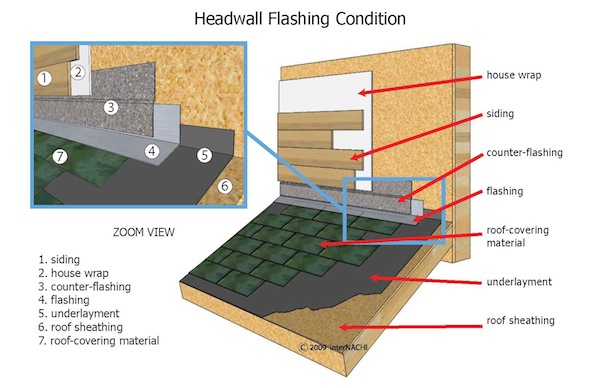
Image via the International Association of Certified Home Inspectors.
Also check for missing or dried-out caulk, as well as any holes or gaps. These are more than cosmetic issues—they can serve as entry points for water and pests.
You can also look for rot by searching for water stains. Try placing your hand on a few different places and pressing gently into your siding. If it has any give, that could be a sign of internal damage. If you find signs of rot in several areas, the sheathing inside your wall is likely rotted.
In any case, if you suspect rot, call a professional to perform a full and thorough inspection.
How To Schedule A Siding Inspection
Whether it’s with a repair or a replacement, your siding is worth addressing. Ignoring problems can lead to bigger, more expensive problems over time.
If left unaddressed, moisture and water damage can spread, creating health and safety risks, energy loss, and costly repairs.
If you’ve noticed something is ‘off’ with your siding, the next step is to schedule a professional inspection to get answers.
At C&L Ward, we’ve helped thousands of homeowners across Southeast Michigan to make their siding safe and beautiful again.
If you’re still unsure whether you need a siding repair or replacement, you can take our quick and easy Siding Quiz: Repair or Replace?. We won’t ask for or store any contact information.
Or, Schedule a Consultation with one of our experts. From there, we will be happy to conduct an inspection, share options, and answer any questions you may have.