





Best Home Exterior Installers with Financing Options: Roofing, siding, and window projects in Michigan
July 17, 2026 | By Pat Ward
Home improvements are expensive, but sometimes they can’t wait. That leaky roof or window might seem costly now, but you know the damage will be far worse if you ignore the problem for another year or two.
At C&L Ward, we’ve helped homeowners with more than 47,000 projects (and counting). Over the past 54 years, we’ve seen lots of financial situations and helped clients find the optimal solution to their problems, while still keeping their project affordable.
In this article, we’ll take a look at local and national installers servicing Southeast Michigan, what financing options they offer, and what common financing terms mean.
Table of Contents
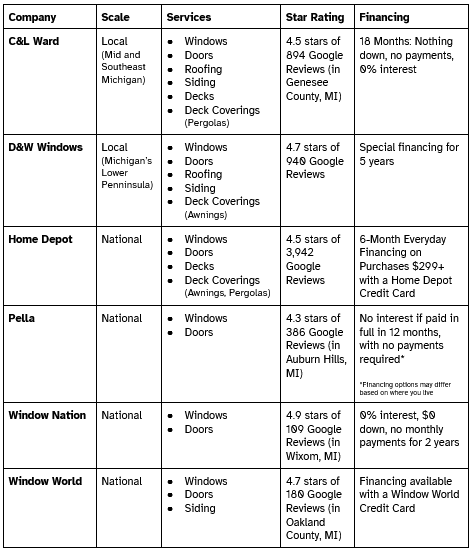
Quick Comparison: Financing Options By Top Home Improvement Companies
In this article, we look at six companies that offer exterior home improvements. Our criteria stated that each company must offer more than one exterior service. Some of these companies may also offer interior home improvements. These interior options are not included here.
We compare both local and national companies. Businesses are simply listed in alphabetical order. The order in which they appear is not a ranking of any kind.
Please note that this article was created based on the financing options available at the time of writing, and some financing options defined here may no longer apply.
Detailed Breakdowns: Financing Options By Top Home Improvement Companies
Company Overview
Beyond reviews, we recommend looking into company history when choosing a contractor. How long have they been in business? Who actually performs the work? Do they service your area?
- C&L Ward: C&L Ward is a family-owned home improvement company. C&L Ward was founded in 1972 and currently serves Mid and Southeast Michigan. Factory-trained and certified employees complete their installations, though products are available without installation through C&L Ward’s retail department.
- D&W Windows: D&W Windows and Sunrooms is a family-owned manufacturer and installer. D&W was founded in 1955 and is based in Davison, Michigan. Factory-trained employees complete their installations, though contractors can purchase and install custom-built windows.
- Home Depot: Home Depot is a retail corporation focused on indoor and outdoor home improvements. The business is managed as a chain, meaning all Home Depot locations are owned and operated by a single parent company. Third-party installers, or independent contractors, install their products.
- Pella: Pella Corporation is a manufacturing company. Pella was founded in 1925 and is headquartered in Pella, Iowa. Their products are installed by Pella installation teams or Pella Certified Contractors.
- Window Nation: Window Nation opened in Maryland in 2006. Since then, the company has grown to serve the country with their factory-trained teams.
- Window World: Window World is based in North Wilkesboro, North Carolina. It was founded in 1995 and now operates as a nationwide franchise, meaning Window World systems and trademarks are licensed to individual owners.
Services and Materials
Each company offers different services and materials, and each of these products comes with their own benefits and limitations.
Wood windows, for example, can be beautiful. But they also require more maintenance than other window materials, meaning they aren’t the best fit for someone looking for a low-maintenance solution.
Be sure to research which materials are best for you and your home before committing to a solution, and find a contractor that meets your needs.
- C&L Ward:
- Windows: UpWARD vinyl, Andersen Fibrex (composite) or wood
- Doors: Therma-Tru fiberglass or steel entry doors; UpWARD vinyl, Andersen Fibrex (composite) or wood patio doors
- Roofing: Owens Corning asphalt shingles
- Siding: CertainTeed insulated vinyl, Everlast composite, or Diamond Kote engineered wood
- Decks: Fiberon composite or PVC
- Deck Coverings: Heartland pergolas
- D&W Windows:
- Windows: Vinyl (The Michigan Window™)
- Doors: Steel entry doors, patio doors
- Roofing: Atlas asphalt shingles
- Siding: CertainTeed vinyl siding
- Deck Coverings: Retractable awnings
- Home Depot:
- Windows: Vinyl and/or aluminum Andersen, American Craftsman, Jeld-Wen, Ply Gem, PGT, and Milgard Windows
- Doors: Steel, fiberglass, and wood entry doors from Jeld-Wen and more; 20+ brands of patio doors
- Decks: Deckorators, Fiberon, MoistureShield, TimberTech, or Trex composite decking
- Deck Coverings: 30+ brands of metal or polycarbonate patio covers; 40+ brands of pergolas
- Pella:
- Windows: Aluminum, vinyl, wood, or fiberglass
- Doors: Wood, fiberglass, or steel entry doors; aluminum, vinyl, wood, or fiberglass patio doors
- Window Nation:
- Windows: Vinyl, wood, or fiberglass
- Doors: Fiberglass or steel entry doors; patio doors
- Window World:
- Windows: Vinyl
- Doors: Woodgrain or fiberglass entry doors; vinyl or fiberglass patio doors
- Siding: Vinyl
Pros and Cons
Each contractor will have different appeals. Depending on what you’re looking for in a project, your personal list of pros and cons might vary. We’ve listed some common factors to consider below.
Pros
- C&L Ward: Lots of material options, customizations available.
- D&W Windows: Factory-direct pricing on locally manufactured products.
- Home Depot: Offers a wide variety of manufacturers.
- Pella: Recognized for innovation, with more than 280 patents.
- Window Nation: Multiple material options and styles.
- Window World: Low prices; products are available in many colors and series.
Cons
- C&L Ward: Smaller service area than state-wide or national competitors.
- D&W Windows: Limited window, roofing, and siding materials to choose from.
- Home Depot: Utilizes third-party installers, not in-house employees.
- Pella: Higher price points, especially for premium lines.
- Window Nation: Limited availability in some regions.
- Window World: Window and siding materials are limited to vinyl.
Warranty Coverage
At first glance, warranties might not seem like they factor into the cost of your project. But they can. Not only do you pay for the warranty when you purchase a product, but they can also save you money if issues arise by covering the costs of replacement or repair.
For a full breakdown of different warranty types and what they protect, read our article, “What are the Different Types of Home Exterior Improvement Warranties and What do they Protect?”
- C&L Ward: Offers manufacturer’s warranties on all products and installation warranties.
- D&W Windows: Available; contact for comprehensive warranty information.
- Home Depot: Offers manufacturer product warranties and a minimum of a one-year service warranty on all installations.
- Pella: Offers Limited (Lifetime) product warranties and a 10-Year Transferable Installation Warranty.
- Window Nation: Offers a Limited Lifetime warranty on parts, materials, and installation.
- Window World: Offers a manufacturer’s lifetime limited warranty, installation warranties vary by franchise.
Financing Options
Smaller companies tend to offer promotions such as “0% Interest” or “No Money Down,” whereas nationwide businesses are more likely to offer discounts when you open a credit card.
Note that these discounts will vary by installer. While some might offer 0% interest, some might still charge retroactive interest. This means, if your project isn’t paid in full during the promotional period, you do pay interest.
- C&L Ward: 18 Months: Nothing down, no payments, 0% interest.
- D&W Windows: Special financing for 5 years.
- Home Depot: 6-Month Everyday Financing on Purchases $299+ with a Home Depot Credit Card.
- Pella: No interest if paid in full in 12 months, with no payments required.
- Window Nation: 0% interest, $0 down, no monthly payments for 2 years.
- Window World: Financing and special promotional offers available with a Window World Credit Card.
How Does 0% Financing Work on Home Improvements?
“0% Financing” means you can pay for your project over time without accruing interest for a predetermined period.
This exact period will vary by company. Depending on who you hire, you may be able to choose from a range of payment plans.
Why Do Financing Options Vary by Company?
Financing options vary largely in part due to a company’s size. Local companies may offer 0% financing as an incentive to local homeowners, but the offer might last only a few months to a few years.
“Smaller, local companies are more likely to offer 0% financing to drive business and allow homeowners to replace their windows when money is tight. Check your area for any companies with flexible financing options. Our nationwide survey found that nearly 30% of respondents financed their window replacement project, making it the second most common payment method behind credit cards.”
National installers may offer 0% financing as part of longer contracts (up to 10 or 15 years) or with a credit card application.
How Can I Save on Home Improvements?
You may have heard of the 30% Rule for Renovations. This guideline recommends spending no more than 30% of your home’s current value on improvement projects.
Beyond the 30% Rule, there are steps you can take to help keep projects affordable:
- Ask potential contractors about discounts. Some offer lower prices if you pay in cash, or sign for your project by a certain date.
- Get multiple quotes. The cheapest hire might not be the best fit for you and your home. But you can find the most affordable contractor for the best quality to suit your needs.
- Understand all costs. Beyond the cost of materials and labor, be sure also to consider loan interest, payments, and service charges.
What Should I Look For in a Good Installer?
- Reviews: Whether their experience was good or bad, customers often write reviews. Be sure to check Google Reviews and other home-specific review sites, such as GuildQuality, Angi, or Houzz, to see what clients liked and spot any potential red flags.
- Longevity: A good company will stick around. We recommend looking at how many years an installer has been in business. A new company isn’t a red flag on its own, but a company that has been in business longer than its warranty period helps ensure your project will be protected for years to come.
- Products and Materials: A contractor might be great at what they do, but that doesn’t help if they don’t offer the products or services you need. Make sure to check that an installer offers the exact materials you need.
- Communication and Clarity: You should feel comfortable asking questions, and should be given clear answers. A quality contractor will handle aspects of your project—such as permitting—while keeping you informed.
- Certifications. A quality installer will be licensed and insured and won’t hesitate to provide proof, such as a Certificate of Liability Insurance (COI), when asked.
You can also use resources such as the National Association of Home Builders for further guidance.
Should I Finance My Home Improvement Project?
You may choose to finance your home improvement project if you understand your installer’s terms and conditions, if your project is urgent enough to require so, and if you are approved for your installer’s financial benefits.
If you’d like to get an estimate of what your next project could cost, try out C&L Ward’s Instant Estimators. By answering a few quick questions, you’ll get a custom range tailored to your project and home.
To get a to-the-dollar quote, Schedule a Consultation with one of our experts. They’ll be happy to answer any questions you have about products, cost, financing, and more.