





Employee Installers vs. Subcontractors: Which Does C&L Ward Use?
May 29, 2026 | By Pat Ward
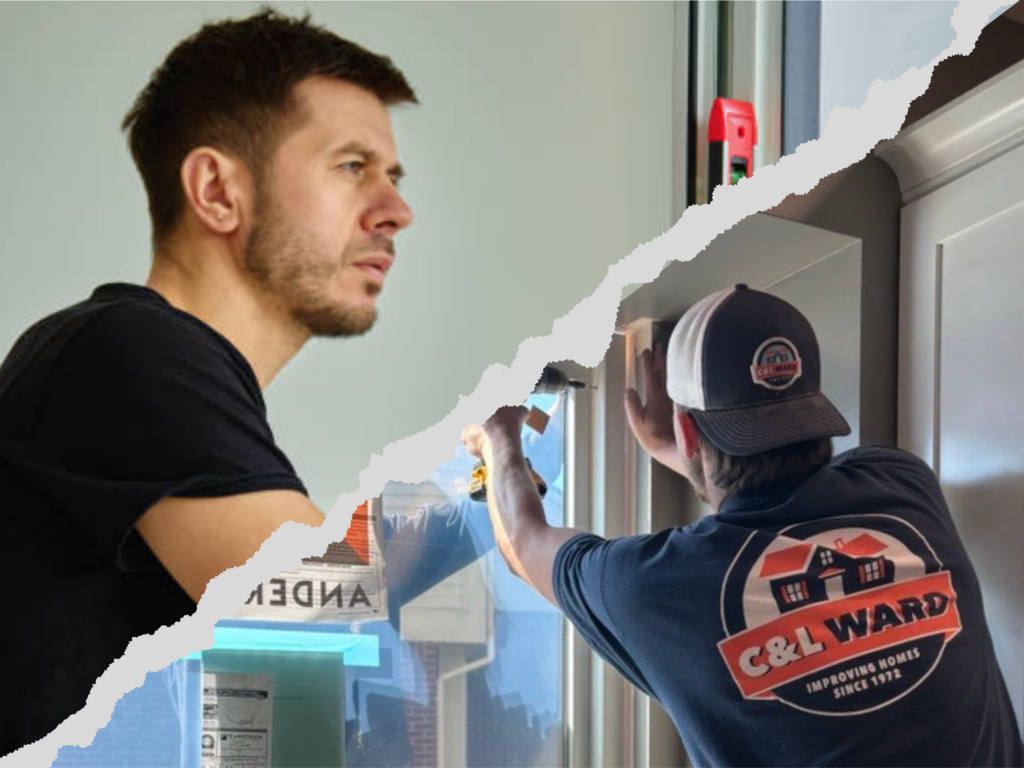
It’s time to replace your windows, door, roof, siding, or deck. Who will be installing your new product?
You might already know who you plan to hire. But who do they plan to hire? It’s a question we ask homeowners a lot, and the surprising answer can be, “I don’t know.”
If you don’t know what questions to ask, you might know which company you plan to hire, but not who will actually complete the labor. Are all of their installers in-house employees? Or do they hire subcontractors to complete the work?
By the time you’re done reading this article, you’ll have a better understanding of the differences between employees and subcontractors, the effect each can have on the quality of your installation, and the potential impacts to your warranty.
Table of Contents
What are the Differences Between Subcontractors and Employees?
An employee works directly for the company you’ve hired. They don’t work with anyone else. They are often trained by the company and have to meet company-specific standards of workmanship.
A subcontractor is a laborer that the company has hired to do work on its behalf. They are paid by the company, but not necessarily trained or insured by the company.
All subcontractors are not the same. Below is a breakdown of some of the key factors between in-house employees and general subcontractors.
C&L Ward Employees | C&L Ward Subcontractors | General Subcontractors | ||||
Accountability | C&L Waed is responsible for quality and satisfaction. | All subcontracted work is inspected by our in-house management to ensure proper code and C&L standards as well before the project is considered complete. | Accountability varies depending on the company and involvement. | |||
Training | Employees are required to receive ongoing training. | Are required to receive ongoing training with C&L Ward. | Subcontractors may be contractually required to receive basic safety training. | |||
Certifications | Our employees are industry-recognized with certifications. | We look for subcontractors with industry-recognized certifications. | License requirements vary by state and municipality. | |||
Insurance | Insurance, liability, and workers’ compensation are covered by the C&L Ward. | We verify that all C&L Ward subcontractors have liability coverage, insurance, and workers’ compensation. | Coverage varies and is not guaranteed. | |||
Training & Certifications | Trained by the C&L Ward and must meet company standards. | Because the subcontractors we do use are trained by us, our standards and warranties are still met. | A quality subcontractor will take pride in their work, but may not be trained on specific products, which can impact warranty coverage. |
What Makes a Quality Subcontractor? How Do Companies Maintain Standards?
We say that our subcontractors must meet the same standards as any of our employees. But how do we ensure that?
By checking the work ourselves. In addition to C&L Ward subcontractors receiving the same training as our employees, we also send an employee to check on subcontractor installations. All products and projects—whether handled by in-house crews or subcontractors—undergo a thorough inspection to ensure the final result meets the same standards as an employee-led project.
Who is Better Trained—Employees, or Subcontractors?
The truth is, it depends on the task. We only trust our Therma-Tru Certified installers to install our entry doors, because they are the most trained in that specific area. In fact, having a non-certified employee install your Therma-Tru door would invalidate the manufacturer’s warranty.
On the other hand, we don’t want a door expert installing your siding. The same logic applies to subcontractors. We could try to be stonemasons and work on your chimney while we install your roof, but wouldn’t you rather have a professional mason handle that? The roof is our specialty, and the brickwork is theirs.
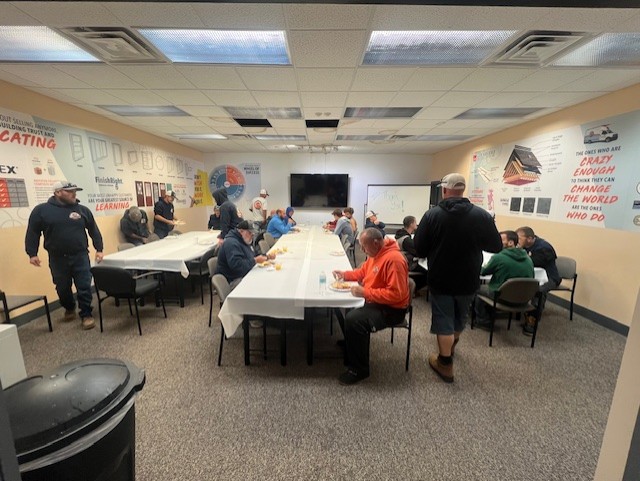
C&L Ward employees and subcontractors enjoy a hot breakfast before beginning company-sponsored training.
Who is Accountable for Work when Subcontractors are Involved?
Accountability will vary by company. Some might offer less oversight, and issues can be more difficult to resolve if responsibility is not shared or clearly defined.
At C&L Ward, we take ownership of every bit of work completed on our behalf. Whether your project was installed by employees, subcontractors, or both, we are heavily involved in project oversight and are responsible for the final result. All projects are covered by manufacturer’s and craftsmanship warranties.
How Does C&L Ward Balance In-House Crews and Subcontracted Workers?
Whether your project will be completed by employees or subcontractors depends on four things:
- The Product
We only utilize employees for window and door installations. For decks, roofing, and siding, we use the criteria below to determine which crew best fits your needs.
- Project Complexity
While all our employees and subcontractors are trained the same, a more experienced team is generally more equipped to handle unique or complex projects.
For a simple project, we will most likely send well-experienced subcontractors who are experts in standard projects. For more advanced, custom projects, we will send the best suited and most experienced crew, typically our in-house employees.
- Project Size
We will also consider the scale of your project. An especially large deck may fall into the more “complex” projects, which may call for a more experienced crew.
- Availability
You don’t want to wait for your home improvements, and we don’t want to keep you waiting, either. Depending on availability and skill, we will assign the right team to you to complete your project in a timely manner. Subcontractors and employees must adhere to C&L Ward installation timelines while maintaining our standard of quality.
Can an Improper Installation Void My Warranty?
Yes, a bad installation can void your product warranty. Depending on how strict the warranty is, a decent job performed by the wrong person or with the wrong tools can also void your warranty.
A non-certified installer completing your project can void your warranty. So can using the wrong screws or caulk. A bad installation, especially one that involves all of these things, can immediately make any warranty claims invalid.
This is why it is so essential to make sure you are getting installation from qualified installers before your project begins.
How Does Labor Type Affect Communication?
Subcontractors rely on contractors for management. This means communication is key. It’s why we at C&L Ward only hire subcontractors who work exclusively with us. We don’t want the details of your project to be lost in a sea of messages or mixed up with another client’s.
The Project Coordinator serves as the main point of contact for you, our employees, and any subcontractors on the job. This helps to keep everyone on the same page and up-to-date, and keeps your project running smoothly.
Will Using Subcontractors Delay My Project?
Subcontractors won’t delay your project or make your timeline any longer. In fact, subcontractors can help to shorten your timeline, as it means more hands are available to work. This means less waiting and more installation.
However, work delays can happen with any job. Manufacturing troubles, weather, and other factors outside of the company’s control can still arise.
Is Subcontracted Labor Cheaper?
You might be wondering, if companies use subcontractors, why not just go that route from the get-go? Big box stores offer the same products and use subcontractors, often for a lower cost than local businesses. Why not save some money?
Certified subcontractors will care about the quality of their work. But subcontractors may not come with a labor warranty. They may also utilize different products, which can affect installation—even something as small as using the wrong screw on a ThermaTru door will void the manufacturer’s warranty.
This doesn’t mean big box stores are “bad,” but it does mean homeowners should carefully consider and compare what’s included—not just the sticker price.
Should My Project Utilize Employee Installers or Subcontractors?
Employees vs. subcontractors doesn’t have to be an either/or situation. Your project can utilize both. In any case, deciding whether to use employees, subcontractors, or both is about understanding which option works best for you and your home.
Be sure to ask questions and understand how each option can affect your warranty. Ask who is responsible for what, and how the people working on your home will be held accountable should any issues arise.
At C&L Ward, we rely exclusively on employee installers for all windows and doors. Some of our siding, roofing, and decking teams are exclusively in-house, while others are comprised of subcontractors. All of our crews work hard to help complete your project right the first time.
Reading this article should have given you a good sense of who completes our projects and why. Your next step is to learn about our process and how long your project could take with our article, “How Does C&L Ward’s Process Determine the Timeline and Schedule of My Project?”
If you’re interested in talking about your project with an expert, schedule a consultation with C&L Ward today. Our consultants will be happy to discuss each step of your project and who will be completing it.