






How to Choose an Installer: A General Risk Checklist and Mitigation Plan for Home Renovations
August 28, 2026 | By Pat Ward
You’re ready to invest in a new window, door, siding, or deck. You know the task is too big to do-it-yourself (DIY), but who should you call in to help?
C&L Ward has completed more than 47,000 jobs—and counting. We’ve helped countless homeowners to understand what a contractor can do for them. In this article, we’ll break down the differences between handymen, subcontractors, and contractors to help you understand the differences between installers.
We’ll also provide tips on how to avoid risks when starting a home renovation project, and what questions to ask an installer before hiring them.
Table of Contents
Solo Handymen vs. Subcontractors vs. Installers: Who to Hire for a Home Renovation Service
Every homeowner, regardless of the service, wants to know how much their project will cost. However, some homeowners make a mistake by looking only at cost.
There is always going to be someone who can do it cheaper. Look at where these ‘cheaper’ options are cutting corners, and know what benefits you might be losing in exchange for a lower up-front price.
Keep in mind that it can be far more costly to pay a professional to fix or rebuild what was improperly installed than to pay an expert in the first place.
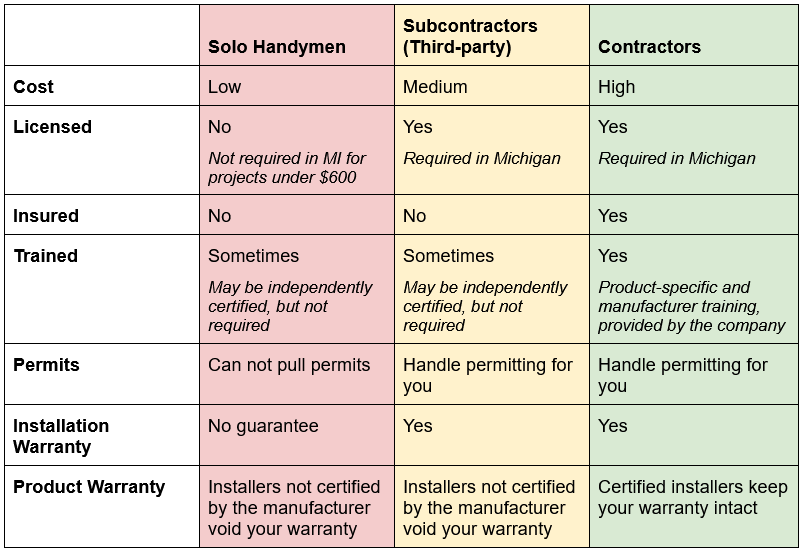
Below, we explain this information in more depth and provide a quick comparison chart to show how these options compare.
Permits and Code
Depending on your project and location, you may need to follow and meet certain criteria. Building codes are laws that set minimum requirements for certain structures. A permit is a legal document granting permission to make structural changes.
The two work together, as permits come with inspections that help to ensure the project is completed safely and all codes are met.
Skipping the permitting process can lead to unsafe, illegal outcomes that may go unnoticed until they break and cause serious harm. If your project is inspected and found not to meet code, it may need to be torn down and removed.
Manufacturer Warranties
When you buy a product, it often comes with a manufacturer’s warranty. This warranty protects your product against any manufacturing defects, provided the product is installed correctly.
In many cases, these manufacturers offer training and certifications. Often, only contractors who are manufacturer-trained and certified meet warranty eligibility requirements.
Installing a product without this training voids the product warranty. Something as simple as using the wrong screw on a Therma-Tru door can make your entire warranty defunct, leaving you (the homeowner) to foot the bill for any repairs.
Installation Warranty
An installation warranty is provided by the contractor or company you work with, not the manufacturer. If your product fails to perform due to improper installation, this warranty can help to cover the cost of replacement or repair.
Contractors and subcontractors both typically offer these warranties, which protect your project from workmanship errors. The exact length and coverage will vary by company. Handymen typically do not offer written installation warranties.
License, liability, and insurance
Licensed installers are recognized by the state. They must pass tests and meet certain requirements, which help ensure they know and comply with local building codes.
Liability refers to who pays for any accidents or damage, whether that be a site injury or damage to a neighboring home. A contractor is liable for any damages and carries insurance to cover associated costs, including medical or repair costs.
An unlicensed crew or an individual performing work on their own may not have these protections. If an accident or injury occurs, you could be held legally and financially responsible as the homeowner.
Solo Handymen or ‘Chuck-in-a-Truck’
Many homeowners ‘know someone who can do it cheaper.’ Maybe your uncle, your neighbor, or your grandma’s cat can claim to do the same work for less. But the truth is, many of these cheaper installations don’t meet the same quality standards as those from a professional installer.
Though we joke about it above, your neighbor or uncle probably does know more about building a deck or installing a window than a cat. But city officials, inspectors, and manufacturers won’t see it this way.
Why? Because all three lack insurance, may fail to obtain permits or meet code requirements, and can easily void your product warranty.
Subcontractors
Some home remodeling companies utilize subcontractors rather than employees. An employee is someone who works for the company and is trained, licensed, and insured by it.
A subcontractor is someone who works for a third party but performs work on behalf of the company you signed a deal with, or an installer you hire from outside the company to perform the installation. They may or may not be licensed or insured, and they may not receive the same training as a true company employee.
Contractors
A contractor is an employee of a licensed and insured company. They are trained by the company, and often take manufacturer certification courses to ensure that the products they install meet certain warranty standards.
Quick Comparison Chart
General Risk Mitigation Checklist
How can you avoid making a mistake when hiring an installer?
Quick Answer:
Research. Ask Questions. See Proof. Trust Your Instincts.
Knowing what red flags to look out for, signs that a project will end up costing more in the long term, and how to identify a quality installer who aligns with the scope of your project is essential to avoiding risk.
Below, we outline a series of recommendations for planning your project, what to ask when speaking with a contractor or potential hire, and illegal ‘loopholes’ to avoid.
Identify Goals
First, make sure you’re searching for an installer who can actually provide the service you need. Research different brands and materials to identify a product that best suits your home. Ask yourself if you’re looking for a low-maintenance option, what your price range is, or if you want a certain finish.
Then, once you have a vision in mind, find quality experts who specialize in that product.
EXAMPLE:
You need a new roof. Searching “best home improvement near me” might bring up a quality siding installer, but that doesn’t fit what you need. Searching “best roofing installers Detroit” may yield better results, but you could get metal roofing suggestions when you want asphalt.
Identifying that you want asphalt shingles and trusting Owens Corning Platinum Preferred Contractors can help you narrow your search to certified installers in your area.
Plan Cost
Identify how much you can comfortably afford in advance. Angi.com recommends a 10% to 20% contingency for unexpected expenses. Many contractors offer monthly payment plans to help keep your project in this comfortable range.
Don’t fall into the trap of high-pressure sales tactics or take on a financing plan for more than you can reasonably afford.
Research Permits
Research your project in advance and see if it requires any permits in your area. You should not apply for any permits, but you should know if you need them for two important reasons:
- A handyman can not pull permits, as the state of Michigan says handymen are only supposed to handle smaller projects. If you’re hiring someone meant to handle small projects to take on a large task, your project may not meet legal requirements.*
- It is ILLEGAL for a contractor to ask a homeowner to pull a permit in Michigan. If a contractor tries to tell you to skip the permit or pull your own, do not hire them.
*Skipping required permits can have serious consequences. Your project may be halted by a stop-work order, you may be forced to remove the unapproved work, and you can face fines for noncompliance.
Schedule an Inspection
No one should ever start fixing up your home without first identifying what they’re fixing. Slapping a repair on an obvious issue, while other problems still lurk unaddressed, means paying for one fix now and a second fix (or a full replacement) soon after.
Whoever you contact should offer an inspection to fully assess and understand the current status of your home. If they want to start work without this, don’t hire them.
SCENARIO 1: You call a window replacement service because you want more energy-efficient glass, but don’t want to replace your whole window. The laborer comes to your home, swaps out the glass, and leaves.
Two years later, you have to replace the full window because you’ve begun to notice water damage around the frame.
SCENARIO 2: You call a window replacement service because you want more energy-efficient glass, but don’t want to replace your whole window. The laborer schedules an inspection and comes to your home, where they notice early signs of water damage.
You and the expert work to find a solution, and you have your full window frames replaced where needed to resolve the issue. You still get the new glass (which looks great) and your windows last for another 15+ years.
Ask Questions
For most criteria, we recommend looking online first. If you can’t find an exact answer from a company, but still want to work with them, call or schedule a consultation to ask questions and get answers. If an installer can’t answer your questions or won’t provide proof to back their claims, don’t sign. Find a different installer who can.
- Who will actually be working on my home?
- What does the price or quote include?
- Do they subcontract or use in-house crews?
- Do you offer installation warranties?
- Can you provide manufacturer warranties?
- Can you show me documentation of your license?
- Can you show me proof of your insurance?
- Can you provide examples of recent work?
- How long will my project take from sale to project completion?
- Do they offer multiple financing options?
Multiple Quotes
Once you’ve identified a few sources you feel confident meet your goals, schedule consultations to receive quotes. We recommend meeting with three installers.
‘Getting a quote’ involves more than just a price. It means asking questions—like those in the section above—about the material, installation process, who will be performing the work, and getting proof of licenses and insurance.
Setting an Appointment
If you’re ready to move forward with a consultation and get a free quote from C&L Ward, you can click to Schedule a Consultation with one of our experts.
If you’d rather compare costs, visit our Pricing Pages to learn more about what drives costs and get an instant estimate customized to your project.