






How Much Do Windows Really Cost in Michigan for 2026?
Mar 13, 2026By Pat Ward
Material, window style, glass, and energy packages will all impact cost. Whether you need a window replacement or a full frame install also impacts the price.
Let’s get right to the point: Most Michigan homeowners pay $1,300 to $3,700 per window installed, depending on product, installation, and warranty. Whole-home installation (with an average of 10 windows) typically ranges from $13,000 to $37,000, with vinyl products priced lower and wood windows priced higher.
In our 54+ years with the industry, the most common regret we hear from homeowners is that they chose a cheaper option and had to address drafts, condensation, or replacements far sooner than expected. We’ve created this article to help homeowners better understand what drives window costs, which features are best for their home, and avoid buyer’s remorse.
This article is designed to help homeowners planning to replace their window(s) in the next 12–24 months, those comparing quotes and confused by price differences, and those prioritizing long-term value over cheapest price
This article is not for renters or those who do not have legal permission to modify their home, those seeking the absolute lowest upfront cost regardless of lifespan, or those looking for temporary fixes only.
Table of Contents
Why Window Costs Are Higher in Michigan
As discussed below, climate demands often require more durable and, therefore, costly window materials and glass in Michigan. Because of the state’s four seasons, extreme cold, and humidity, the cost of a window in Michigan runs slightly higher than the national average of $300 to $1,200.
This could mean that installation and labor cost slightly more, though for good reason. These efficiency ranges and benefits can be meaningless if the window itself is not installed correctly. Paying for quality labor may mean the installation costs more upfront, but saves on repairs and wasted energy in the long term.
What Drives Window Costs Up and Down
The Window Material Itself
All windows naturally fluctuate with temperature, expanding in hot or humid environments and contracting in cold or low-humidity environments. Michigan’s four seasons or even daily differences in weather require windows durable enough to withstand this process without warping, rotting, cracking, or other damage.
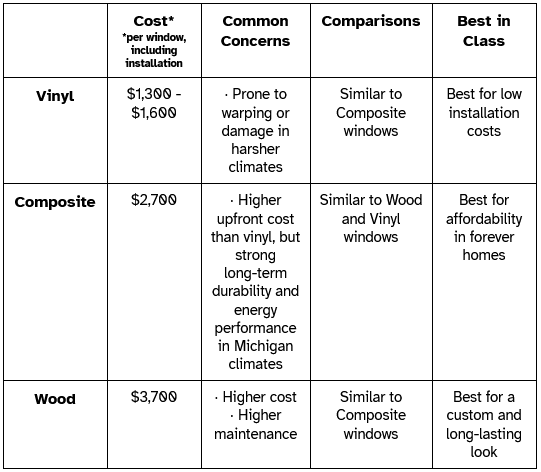
Different materials have different prices, depending on the cost to manufacture and ease of production. In our article “Aluminium, Composite, Fiberglass, Vinyl, or Wood Windows: Which Window Type Is Best for Michigan Homes?”, we made a quick comparison chart of common material types.
Some materials, such as fiberglass, are not included in this chart or article. Fiberglass is great at surviving in heat and humidity—making it a nice fit for southern climates—but it is not a window material we recommend to Michigan homeowners, given the similar effectiveness (and superior cost-benefits) of composite windows in the Midwest.
The Style Of The Window
Windows are available in different series, each with a standard starting point. This base cost is largely influenced by frame material. Choosing a series will ensure that all windows installed visually match, regardless of shape or size.
Some windows only offer one exterior color. Others might offer three, or five, or twenty. The color you select may cost more, especially if you select a faux-wood or more intensive design.
The same is true for interior color, which may also be customized.
Though not a required feature, clients looking for a more unique look may opt to add grilles for texture and variety. Grilles may be permanent or removable, and applied to one side, both sides, or the inside of the glass.
You will also need to select screens and glass for your window. Often, even more basic series frames can utilize a variety of options.

Glass
For a custom look, you might opt for decorative or specialty glass. For example, Andersen offers art glass patterns, similar in appearance to stained glass, and many retailers offer patterned glass. These extra details require more effort to manufacture, which may increase cost. Patterned glass offers a more obstructed view for privacy, without blocking out natural light.
Energy Efficient Packages
Along with aesthetics, glass also plays a large role in the energy efficiency of a window. Some glasses will offer more insulation or better block ultraviolet light.
To meet the U.S. Department of Energy’s recommended energy-efficient scores, Michigan windows may require more layers of glass or coatings, which raises prices. There are two scores to consider, U-Factor and Solar Heat Gain Coefficient, which are affected by glass options. This includes dual- or triple-pane insulating glass, coated, or non-coated options.
A U-factor measures a window’s insulation, with a lower number indicating better insulation. The Solar Heat Gain Coefficient reflects how much solar heat passes through a window on a scale of 0 to 1, with a lower number indicating less heat from the sun.
For northern climate zones, including Michigan, the DOE recommends a U-factor of <0.30 and any SHGC to meet prescriptive energy codes.
For equivalent energy performance, the DOE also recommends a U-factor of -0.31 and a SHGC of >0.35 or -0.32 and >0.40.
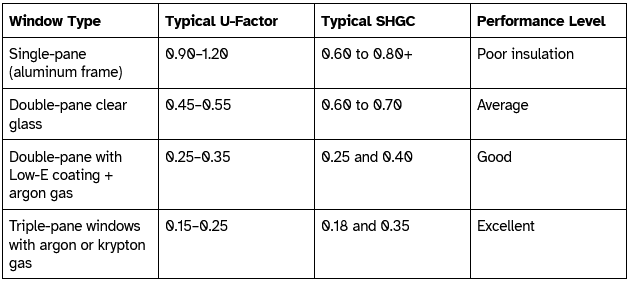
Table in part from The Window Source of Western Michigan.
What all this means is that lower numbers = less heat loss. If you live in a more frigid part of the state, or simply want to better maintain heating and cooling inside your home, consider a double-pane window with a Low-E coating, and potentially an added gas.
If minimal heat loss isn’t a concern to you, a double-pane window with a Low-E coating may be sufficient.
The Replacement Method: Insert vs. Full Frame Replacement
Your final cost will also depend on the number of windows installed and whether you are replacing them with inserts or a full frame install.
Windows are typically sold per unit and include installation costs in the price. A single window and installation averages around $700 to $1,500 in Michigan. An average home has around 10 windows, meaning a standard whole-home replacement ranges from $7,000 to $15,000 on average.
Window inserts keep the existing frame, making them less expensive than full-frame replacements, which replace the window and the frame that encases it.
Insert Window Replacement
- What it is: Also known as a “frame-in-frame replacement,” a “pocket window,” or “retrofitting,” this process removes and replaces your window’s sash and glass but leaves the existing frame intact.
- Intended For: When you want to preserve existing trim, and your existing window frames have maintained structural integrity.
- Cost: About $1,500 per vinyl window to $3,450 per wood window, including installation.
- Common Concerns: May not be as energy-efficient, lose ½” of glass space.
- Not For: Structurally unsound frames, or those looking to change window shape and/or size.
Full Frame Window Replacement
- What it is: This process removes the entire window—sash, trim, and frame—to expose the structural framing. A new window and frame are then installed.
- Intended For: Changing window shape or size, replacing rotted or unsound frames, and adding further insulation.
- Cost: About $1,800 per vinyl window to $3,700 per wood window, including installation.
- Common Concerns: Higher cost, more labor.
- Not For: Those with secure frames looking for lower-cost options.
Comparing Short-Term Cost vs. Long-Term Value
- It may be easy to look at a dollar value and see the short-term price, but forget about the long-term cost. Price is an important factor to consider, but it should not be the only factor you consider when it comes to the longevity of your comfort and home.
- Opting to skip out on energy-saving products can lead to heat and energy loss in cold climates, raising your bills in other areas. Implementing a quick-fix in place of what should be a permanent solution can save money in the short-term, but allows problems to worsen and become more costly in the long-term.
- It is also important to keep maintenance and lifespan tradeoffs in mind. Wood windows can last for decades, but only if properly maintained. Consider your lifestyle and what maintenance routines fall best within your abilities.
Also consider longevity. If you’re in a home you plan to stay in long-term, a longer-lasting product may be worth the initial higher cost, as opposed to a cheaper option that you have to replace again down the line.

While vinyl often appears cheaper upfront, homeowners who plan to stay in their home long-term frequently spend more over 40–60 years than they would with a higher-quality composite option, and may even begin to see savings as soon as 5 or 15 years after installation.
How to Compare Window Quotes (And Avoid Overpaying)
- Create a quote checklist to help compare installers and costs. Read online reviews and check for proof of licensure, certification, and insurance. Ask if work is completed by employees or subcontractors. Ask about timelines, permits, cost of permits (if applicable), how old windows will be disposed of (and if this cost is included), and payment options.
- Watch for any red flags during these initial stages. You shouldn’t feel pressured or rushed by sales tactics. Keep an eye out for companies that use subcontractors—this isn’t inherently a red flag, but companies that do all work in-house may be more streamlined, provide better communications, and better equipped to back up their work post-install.. Check reviews carefully to see how companies that utilize subcontractors compare.
- Consider prices carefully. A lower payment for a poor install now could cost you more in the future, but you also shouldn’t overpay for a product. Hear multiple quotes and estimates, ideally from your top three choices.
- Quote comparison: Some quotes may include permits, disposal costs, or labor. Others may not. If your quote is under $1,000 per window installed, check if any of these costs are missing from the estimate you received. If they are included and the cost is still too low to be true, it often means corners are being cut in materials, labor, or long-term performance. That doesn’t always show up immediately — but it often shows up in drafts, condensation, or premature failure within 5–10 years. If your quote is high, double-check timeframes and what you are being charged for. Make sure the number of windows and materials billed is in line with what you discussed.
Ways To Save Money: Window Financing, Rebates, and Tax Credits
- Many businesses will offer financing options with a variety of payment options and timeframes available.
- Certain energy-efficient improvements may qualify you for a federal tax credit of up to $3,200 each year.
- Your community may also offer local incentives. In Michigan, Consumers Energy offers rebates on qualifying window and insulation projects, as does the Michigan Home Energy Rebates (MiHER) program.
Proceed with caution. If a project is out of your budget, don’t force it. A low payment upfront may come with a long-term interest cost. Be sure to read and understand all details and conditions carefully before signing any financing plans.
FAQs About Window Costs in Michigan
Will the price of window installs go up due to tariffs?
While tariffs can influence pricing, the biggest drivers of cost are still material choice, energy efficiency requirements, and installation quality.
Some materials may now cost more due to tariffs. For example, a project to install wood windows using lumber sourced from Canada will see a price increase compared to previous years.
Can windows be installed in winter?
Yes. Though the timing is up to you, windows can generally be installed year-round in Michigan.
Can I replace just one window? / Should I replace all my windows at the same time?
You can replace just one window at a time. However, there may be discounts available when you purchase more than one product at the same time.
For the best visual appeal, we recommend replacing all windows on the same side of your house at the same time, even if you aren’t replacing the full house.
Should windows be ENERGY STAR certified? / What makes a window ENERGY STAR certified?
A window is ENERGY STAR certified if it is manufactured by an ENERGY STAR partner, has been independently tested, certified, and verified by the National Fenestration Rating Council, and has received an NFRC rating that meets the energy efficiency guidelines set by the US Environmental Protection Agency (EPA).
Material, size, and glass can all impact the energy efficiency of a window. Benefits may include decreased energy bills, tax rebates, and increased comfort in your home. Andersen and UpWARD windows are ENERGY STAR certified.
Are triple-pane windows worth it?
Triple-pane windows are great for energy efficiency, but the third layer of glass means less room for argon gas. This can make it harder for light to pass through, meaning you might notice a slight reduction in natural light. With more materials, triple-pane windows also come with a greater weight and cost.
If you’re near a busy road, have comfort complaints, or want maximum winter performance, triple-pane can be worth it — but for many Michigan homes, a high-quality double-pane Low-E package is the best value.
Material, size, and glass can all impact the energy efficiency of a window. Benefits may include decreased energy bills, tax rebates, and increased comfort in your home. Andersen and UpWARD windows are ENERGY STAR certified.
How long is a typical window warranty?
Material durability factors into how long a product will be covered by warranty. A product may be covered by a lifetime warranty, which spans as long as the estimated lifetime of the material in a given climate.
Material, size, and glass can all impact the energy efficiency of a window. Benefits may include decreased energy bills, tax rebates, and increased comfort in your home. Andersen and UpWARD windows are ENERGY STAR certified.
How to Get an Accurate Window Cost for Your Home
In summary, estimates vary. It’s important to know why (window size, customizations, materials) to help determine if you’ve been given a fair price.
Take the time to evaluate each business you’re seriously considering partnering with, and compare services, products, cost, timelines, and reviews. Be sure they offer the service you need, whether that be an insert, a full frame replacement, or a different fix.
If you’re ready to start looking at estimates, we offer a free online Window Price Calculator.